
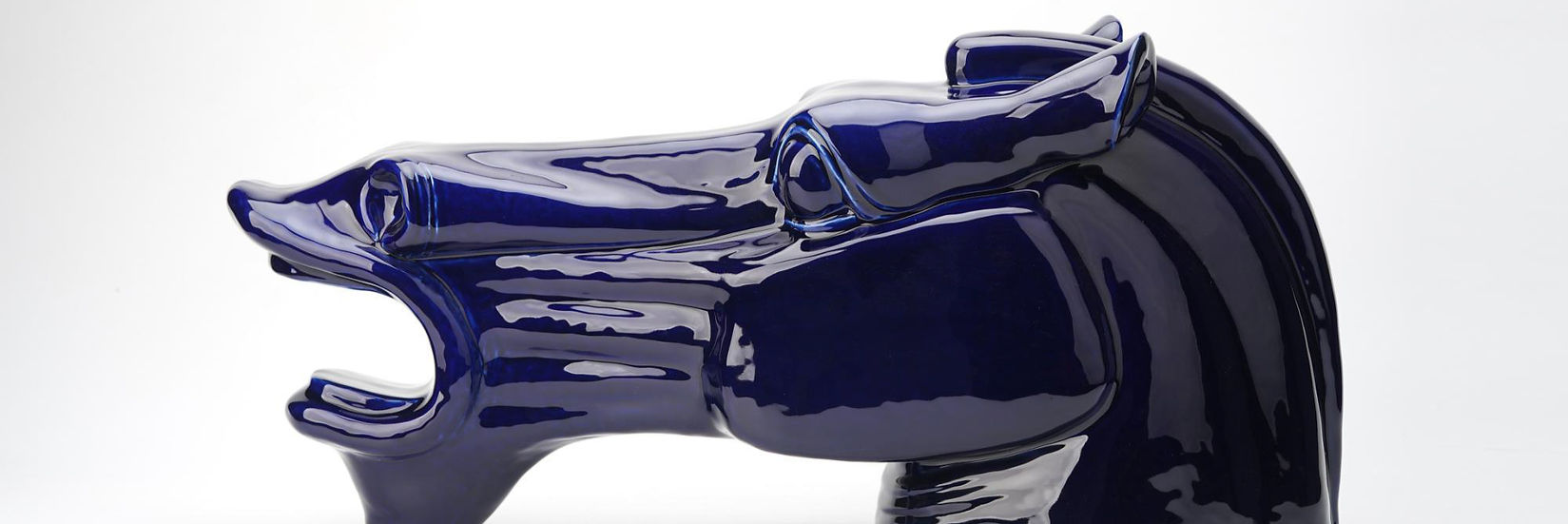
Tang Cheng was born in Inner Mongolia, where horses are not symbols but companions. He studied sculpture at Jingdezhen Ceramic University and at Taiwan's National University of Arts, earning an MFA that gave him formal command of both Eastern and Western sculptural traditions. He returned to Jingdezhen and began making horses.
The horse has been a subject of Chinese art for over two thousand years, from the bronze galloping horse of Gansu to the Tang Dynasty sancai tomb figures that are among the most recognised ceramic objects in the world. Tang Cheng's contribution to this lineage is distinguished by two things: the intensity of his surface treatments, using high-temperature colour glazes, Jun red glazes, and modern gilding techniques that give each sculpture a molten, almost geological quality; and the emotional directness of his forms, which carry a vitality that connects them more to living animals than to museum objects.
His work operates on two scales. The collector tier consists of limited edition sculptures, produced in editions of 20 to 99, priced from £1,100 to £2,500. These are substantial pieces, intended to anchor a room. The accessible tier consists of cultural creative products: miniature horses, zodiac figurines, and gilded horse series, priced from £8 to £90, with professional gift packaging. This dual-track approach is modelled on Lladró and other successful ceramic houses that maintain artistic credibility while building a broad collector base.
Tang Cheng works primarily in high-temperature colour glazes, a technique where metallic oxides suspended in the glaze undergo unpredictable chemical transformations in the kiln. No two firings produce identical results. The surfaces of his sculptures carry the evidence of this process: deep reds shifting into purples, blues bleeding into greens, the glaze pooling and flowing in ways that the artist can influence but never fully control.
His Jun red glaze work references one of the most celebrated glaze traditions in Chinese ceramic history, the Jun kilns of the Song Dynasty, whose copper-red glazes were considered so precious that they were reserved for imperial use. Tang Cheng's contemporary interpretation pushes the palette further, combining Jun reds with modern gilding and monochrome glazes to create surfaces of remarkable chromatic complexity.
Fifteen group exhibitions (2014-2023) including the Asian Contemporary Ceramics Exchange Exhibition and China Contemporary Art exhibitions. Three solo exhibitions: Sanbao Peng Art Museum (2019), Xiaogan City (2021), Jingdezhen Hyatt Centric (2023). Eight major awards from the China Ceramic Industry Association, including Gold Award (2022) and Grand Prize (2020). Works collected by Pierre Cardin (《风行》/ On the Wind, 2018), Jingdezhen Ceramic University, Jiangxi Provincial Arts and Crafts Museum, and the China Ceramics Museum.